

J – Smash – I Don’t See You Niggas Featuring Ginger Trill, Tumi Tladi & WiziBeatz
by Phil Chard

Limpopo based 17 year old producer and DJ J-Smash just dropped the trap anthem I Don’t See You Niggas featuring Ginger Trill & Tumi Tladi and Wiz Beatz.

Gemini Major – Ragga Ragga Featuring Riky Rick, Nadia Nakai, Cassper Nyovest & Major League
by Phil Chard

Malawian producer and artist Gemini Major has been cementing his name in the African and South African scene for some time now with his fair share of production and feature credits. Since signing with Cassper’s Family Tree imprint he has helped secure his position in the South African urban movement. Despite a few poplar collaborations with the likes of Khuli Chana & DJ Waxxy , his new single Ragga Ragga looks poised to be his biggest single to date.
The trap and dancehall influenced song features Family Tree and its affiliates - Riky Rick, Cassper Nyovest , Nadia Nakai and the Major League twins (????). The song’s extremely minimalistic and repetitive chorus is a serious earworm that promises to be a dancefloor favourite especially on Thursdays at Baseline.

Takura – Zino Irema (Official Video)
by Phil Chard
Soul Afrika is a Pop group that first broke onto the Zimbabwean music scene two years ago under the ABBRA Tribe umbrella. When I interviewed Tytan around that time he had been working closely with the group in a managerial capacity.
Since releasing their debut effort Ndimi Derudo the duo of Takura and Tatenda Mathe seem to have moved on to form a close relationship with Kenako Music. Now it seems the group are also trying their hand as solo acts
In his new single Takura experiments with a different sound to what his fans may be accustomed with. The track Zino Irema is surprisingly very Hip Hop and features Takura on a trap beat blending rap verses and sung choruses as he sings about fake friends and a woman who doesn’t have any genuine interest in him outside of the superficial .
The video was directed by Zimbabwe’s premier director Andy Cutta and is a highly impressive offering that integrates studio and outdoor shots featuring Takura and his cohorts dabbing enthusiastically as they recite the sombre lyrics.

Ras, PdotO, N’veigh & Blaklez – RAP
by Phil Chard

The year was 2012, December if my memory serves. I was sitting idly by minding my business when I was sent a link to a song titled Al Pacino by the Cap City quartet of Ras, Pdot, N’veigh and Blaklez. The song was incredible and displayed the pure lyrical talent possessed by each of the labelmates, sadly there didn’t seem to be much of a push behind the track. Requests to get hold of the artwork proved fruitless , so I decided to design the artwork for them. (The song was that dope).
Now 2 years later the same 4 rappers are back again to do damage. This time on Rap the four rappers take turns trading bars on a track that boasts a 16 bit game sample and quarter note hi hats . Once again they all display an incredible amount of lyrical prowess as PDot & N’veigh engage in a battle of alliteration while Ras and Blaklez try out punchline each other.

Akan – Helebaba Featuring Worlasi
by Phil Chard

Worlasi has fast become one of the blog’s favourite artists. With his unique style and smooth vocals he has been a breath of fresh air in the sound coming from the West. Worlasi recently linked up with Akan on the Qube produced song Helebaba and the result was nothing short of incredible.
@worlasirb
Akan-Helebaba

DJ Spinall – Package (Official Video) Featuring Davido & DelB
by Phil Chard
DJ Spinall aka The Cap just dropped the video for the Del B & Davido assisted song Package. If my initial thoughts on the Ndvdual Pictures directed video could be summarised in a meme it would be McKayla Maroney at the Olympics. In 2016 a video that relies so heavily on overused tropes and techniques won’t cut it. It is not like I am being unfair, this after all is the same DJ that gave us this video.
The video for Package is not bad , it’s just “meh” from a DJ who has built his brand and persona as someone who would rather be caught dead being ordinary. Last week DJ Spinall was looking to a Ferrari or Lambo in Lagos. I really wish he had found it so the video had more visual appeal than objectified black women and obligatory alcohol placements. At some point after you’ve seen a voluptuous video vixen in leather, you have really seen them all.

Viber Public Chat with Rosah-Joy
by Phil Chard

The African Hip Hop Blog was chosen as one of Viber’s launch partners when they launched their new Viber Public Chat feature a few months back. Since it began we have experienced tremendous growth and engagement on the platform. We use our Viber public chat as a forum to allow for discussion and debate cantered around the African music industry and the culture. We encourage anyone interested in getting the latest news and opinions from influential voices across the continent to follow along. If you would like to be part of the debates and contribute, please get hold of me on twitter @PhilChard.or the blog @africanhhb
This week for our Viber Public Chat we interview Zambian artist Rosah-Joy.

Review : Rosah-Joy – Pressed EP
by Phil Chard

The best thing about being a music blogger is the rare occasion when someone introduces you to an artist so impressive you are angry with yourself for not discovering them sooner. That is the feeling I experienced when I was sent the new EP by Rosah-Joy titled Pressed.
Rosay-Joy is an artist that fuses Hip Hop, R&B, Soul and Spoken Word into her music to produce an incredible product. Born in the Southern Province of Zambia and raised in Queenstown, South Africa who then went onto attain a Bachelor of Arts degree from The Art Institute of Washington. This eclectic mixture of cultures all play a help in shaping the artistic identity of her music. Her delivery has the distinctive cadence of a Zambian (I can’t explain it but when you talk to a Zambian you will understand), that fuses the isiXhosa she learned in South Africa and the Western influence that paints her style and accent.
I did a brief Tweetview (Review on Twitter, see what I did there?) of Rosah’s latest offering. In summary it is a massively impressive project that takes the listener on a brief and emotional ride from the vantage of a woman as she speaks about the emotional experience of dealing with a failing relationship.
Rosah - Pressed Tweetview - Curated tweets by AfricanHHB

Slanging SA Hip Hop

So we all know where the term “Stan” came from, right? Eminem’s track Stan birthed a noun that carried much more significance than just naming. It became the go-to-term to describe a die-hard fan, hell-bent on attaining adoration from their favourite rapper. It’s become an adjective symbolizing obsession. Sorry to all the non-fanboy Stans out there, it’s how the cookie crumbles!
The origin of how Stan has become a frequently utilised adjective is really intriguing though ‘cause it shows just how much longevity slang words coined, or promoted, by rappers can take hold of our collective vocabularies. Well, have you ever wondered how some of your favourite South African rapper’s slang words came about? Which rapper popularised a term… or which slang words we’re using now will stand the test of time? Let’s have a look.
The Whole Design or The Whole Time is a phrase largely attributed to Ricky Rick. It’s littered all over his tracks including P.A.I.D, where he’s featured by Da LES. What few know is that the term is the property of one-third of the legendary TKZEE. Magesh aka Tokollo who first rhythmically brought the catchy description to our attention in Khala Kahle off his album Longest Time. To be fair to Riky Rick his term that shares the song title Sidlukotini has even been translated to Cotton Eaters for the benefit of the trust-funders amongst us. His crew BoyznBucks rarely get credit for their effect on the culture either. From being on the frontline of trends such as forming their own Racing Apparel clothing line to creating a craze in the form of the Taxi Driver dance; they’ve also coined terms such as uMswenkofontein… and the Swenk Korobela as heard on Okmalumkoolkat’s Free 100k Macassette. These terms signify where the fun is at and being swagged out from head to toe.
A BoyznBucks admirer and Okmalum’ collaborator on his breakout hit Gusheshe, Cassper Nyovest showed us his appreciation of the trendsetters with his version of the Taxi Driver dance in the Phumakim video. He’s also credited with coining the phrase “Upper Life”… or simply “Upper”. This statement is used to depict the levels he’s reached and the subsequent luxurious lifestyle he has come to lead. Speaking of Levels, the word not only served as the title for AKA’s sophomore album but led to his frequent collaborator dubbing himself as self-styled North God. Da LES was also a fervent user of the phrase Fresh to Def, which is still confusing to many!
By now it should be obvious that most slang terms used by rappers are meant to exalt their standing in the game. From how they live, to how they dress… their dopeness is in every inch of their fabric. This is a cornerstone of being a rapper, it is a competitive sport… sometimes involving contact but mostly about hyperbolic display. It’s no surprise then that braggadocio comes across both songs and music videos. Speaking of visuals; a visible element of AKA’s repertoire has become his trademark shoulder roll. His dancing has become a larger factor in his live performances, but his vocabulary has also contributed to contemporary South African Hip Hop jargon.
Following the lead of Nigerian maestro Don Jazzy, AKA starting out by hailing himself as Doro Mega, until he finally settled for the Supa Mega. In 2014, he had everyone either under supervision or control after the release of his catchy club joint Kontrol featuring the North God Da LES. The Cape Town-born rapper and his crew have since expanded their diction and now you’ll hear a lot of Shuuu! and how everything is a “a dream, a movie or just a lot mate!” Speaking of movies; Youngsta’s Top Ten List portrays him as a slasher hell-bent on exacting revenge on the Hip Hop game overlooking him. Also audible is his trademark callout of Kaapstad Naaeir, loudly repping his city whilst popularising the term. Youngsta also often chants Salutas, to shoutout his hood. He also mentions his native Wynberg and on the remix of Ejay’s Hosh which features both him and Fonzo. Incidentally Hosh, also popularises cape slang and exposes the mainstream to it whilst showing some solidarity for Cape Town Hip Hop. The catchphrases our favourite rappers use seem to seep into our everyday lexicon, without us even realising it.
One can’t have a conversation about expressions without considering Blaklez’s Aaaah Yes, Ifani’s Brie or Khuli Chana’s RRRAAA! The next time you drop a fashionable phrase, ask yourself where you heard it first. It might just have originated on the street corner, from a catchy 90s track or may be the product of your favourite rapper’s imagination. It will be interesting to see which of these phrase last as long as Magesh’s, which served a previous generation musically and is still being use the whole time after such a long time!

Emtee & Falz Nominated At The 2016 BET Awards
by Phil Chard

Emtee, Falz and Tkay Maidza nominated for a BET Best New International Act Award at this year's BET Awards
The BET Awards just announced the nominee for the coveted BET Awards Viewers’ Choice “Best New International Act” category. Among the nominees are three African Hip Hop acts; Tkay Maidza, Emtee and Falz. Other nominees include Emtee (South Africa), Falz (Nigeria),MHD (France), Tkay Maidza (Zimbabwe/Australia), WSTRN (UK) and Section Boyz (UK).
Watch our BET nominees Playlist
The nominations for both Falz, Emtee & Tkay come off the back of incredibly successful years for the artists. Falz released his debut album Stories That Touch with massive videos like Celebrity Girlfriend and the Clarence Peters directed short film Soldier featuring Simi. He also walked away with an AMVCA for Best Actor In A Comedy.
Emtee has been a force of nature since he stormed into the industry , dominating radio , the charts and sweeping awards in his wake. The Soweto rappers just won two awards at the SAMA awards this weekend as well the four awards he bagged at the Metro FM awards in February.
TKay Maidza is a Zimbabwean born artist who merges Hip Hop and Pop. She relocated to Australia when she was 5 years old. After singing to Universal Music imprint Drew Records in Australia she has released the 2014 Switch Tape, which included videos for Uh-Huh, M.O.B and Switching Lanes.
Fans can vote their favourite act at BET.com or by tagging @BET_intl on Twitter and Instagram using the hashtag #ipick. Voting for the Viewer’s Choice category is now open, and will close on 22 June at 00:59 CAT.
The 2016 Awards will be hosted by Anthony Anderson and Tracee Ellis Ross, and will take place on the 26th of June in Los Angeles, California.
The BET Awards premieres on BET (DStv channel 129) on Tuesday 28 June at 19:00CAT.
The BET Awards will take place along with the BET Experience at L.A. LIVE in Los Angeles from 23-26 June 2016.

The Machine Rages On- Tipping The Skales On Record Deals
by Mayuyuka
There have been great breakout successes for independent artists all across the world lately. In the States Chance The Rapper and in South Africa Cassper Nyovest has built himself an empire with his record label Family Tree.
For every great indie success, however, there's a lot more successful artists with label backing. Now what about those successes who we see hit the limelight but are signed to deals which seem aren't in their favour. Once in a while, the curtain is pulled back and the façade of bottle popping and fresh whips gets put firmly in the spotlight.
Well, Skales is a prime example of a major signing gone wrong it seems. With news of his and his managers arrest, a slew of documentation has surfaced on line. The Nigerian signed a reported 200 Million Naira deal with Howie T and Dipo Abdul-helmed record label Baseline Music.
Now if this is all factual, it intrigues me cause the deal purportedly included a new car, a lifestyle allowance and a new house (legally, and not mistakenly referred to as property). Now I say that somewhat facetiously but the point of ownership is essential to talk about when we speak of record deals. Along with an artist receiving an advance to record music with the best facilities available to them, all these other perks are considered loans from the record label. It's an investment the label makes in an artist, and like any other investment a healthy return is expected. That means any advances offered to an artists have to be paid back through sales and a cocktail of other revenue streams. Before that debt is settled though ... the label has access to any surety it can get. Surety is literally insurance on the prospect of future losses. Put simply, an artist's value is tied to the label for as long as they're contracted to them: until they recoup a return.
Now lets track back a little: A label willing to give an artist an extreme makeover (rapper edition) deluxe package isn't being charitable and is just putting as many eggs into a basket they believe in as they see fit. So it wasn't a surprise to hear that Skale's earnings were purportedly divided between a 70– 30 percentage split in favour of his label. This agreement applied to income from both his current and any previous deals apparently, meaning he sold off his previous and potential earnings to a corporation. What's most striking is the alleged 10 Million British Pound fee he'd have to pay to buy himself out of the contract.
I'd hazard a guess that the typical 360 Degree Deal is responsible for a lot of artist's unhappiness. In such a deal the label has access to an artists image rights, copyright, performance bonuses, syndication fees, royalties, publishing rights and literally any other income the artist earns. All signed away in exchange for the access and perks the label provides. As preposterous as that sounds, it is somewhat the norm. It sounds harsh on an artist, but when you have access to an allowance, studio facilities, distribution and other perks the price to retrieve your freedom is pretty high! In Nigeria alone there have been a range of artists leaving after being at loggerheads with their labels. Here's a few of the verifiable accounts we have so far:
Milli just parted ways with Chocolate City apparently due to having his music unsupported by the label and a collaboration with Wizkid shelved. He goes so far as accusing label honcho M.I Abaga of stifling his career! We've seen contractual disputes between D'banj and Don Jazzy tear apart their partnership as well in eerily reminiscent fashion. Meanwhile, Ice Prince has moved on to form his own label, also relinquishing any ties he has with Chocolate City. Although this reportedly happened in 2014 and probably seems like a natural progression for him.
What seems very un-natural is the relationship with Runtown and Eric Many Entertainment. His label allegedly breached their contract after failing to pay him his 35% split over a couple of years. He has a sordid tale to reveal which includes broken promises, extortion and death threats! The artist was banned from performing due to an injunction and subsequently terminated the agreement.
Here's a run-down of other Nigerian acts who split from their label, as per Pulse:
This sort of strife for artists isn't only isolated to Nigeria, as in South Africa there are plentiful stories with artists signed to labels such as Ghetto Ruff where popular musicians such as Ishmael and Zola have had varying disputes with label head Lance Stehr. Kenyan femcee Xtatic recently had an online outburst aimed at her label: A major record label she blamed for allegedly shelving her project even though she met her end of the deal. She goes on to list more East African talents she feels have been exploited in her exasperation, such as Ugandan rapper Keko. The problem is clearly not limited to individuals either as the issues Zambian outfit Zone Fam have with Kenyan label Taurus Musik prove.
It seems year after year we hear stories of beloved artists passing away broke and the like. And this is where stories like these take my mind. There are whispered tales of composers of indigenous music having their work owned by people with foreign names... and even artists' families inheriting their indebtedness! The vast amount of African legends, in any genre, that have been dealt hands they either were unaware of or misunderstood is extensive. Even if a label sounds like the underdog in relation to mainstream players... every label operates like a label: whether it is indie, an imprint or multi-national. In the relationship between artists and label the word partnership only counts in press releases and is rarely accurate. You are employed by a label to recoup it's earnings, and in the meantime anything attached to you they own!
The tales of these artists converge to remind us that the music industry functions on a lot more than just talent, hype or the glitz and glamour us consumers literally buy into. Even talented artists require an understanding of what they seek to achieve. Sometimes being independent is the best way and other times a label provides much needed distribution and reach. All this, however, should be negotiated. When signing to a label not every right needs to be cashed in! Without keeping some form of musical ownership... great strides such as the quotas in Nigeria or the newly enforced 90% local music on South African radio will all be in vain. With no publishing or royalties to their names, there'll be very few benefits for the talented folk who entertain us!
We've spoken about having a great team around you in a musical sense before. But an artists squad goals should include certified managers, publicists, accountants and more especially lawyers. We need people to turn up with, but we also need people to turn up... when we need help signing on the dotted line!

Caleb Kalz – Feedback Featuring Manu
by Phil Chard

South African based Caleb Calz just dropped a new joint titled Feedback . The track is accentuated with piano keys and an infectious drumline as Caleb and Manu (Jack Scouts 2015 finalist) deliver some impressive verse. The big standout of this song was Manu on this joint who we featured before here

The State of Hip Hop In Bloemfontein
by Contributor
We’ve just reached the halfway mark of the year, and Africa is still giving birth to Hip hop bangers that are definitely worth reaching your eardrums and eventually landing on your playlist. I’m here to bring you 2 bangers that were birthed in the city of Bloemfontein not so long ago. The city has been singing along to Badabing and To The Max ,and there’s no doubt that these jams are going be on repeat on your phone and systems for a while. First up, we have Castino (real name Katleho Smaye ) who dropped the ASID produced Badabing

Castino has to be one of the most energetic and vibrant rappers to hit the Bloem Hip hop scene, and I’m sure those that have watched him perform can also testify on this. Castino the Hero describes himself as an Author (his first EP was entitled The Author EP) and the “King of Gomora Rap”: A style of rap that has Bloemfontein lingo and slang. It’s difficult to question he’s talent when it comes to spitting well-crafted rhyme patterns and having the ability to tell different stories through his verses, plus most people would agree that he’s lyrically gifted. With catchy lyrics like
“When I go – Oh my god, Badabing, you go – Santse Re Phela”.It promises to be an earworm.
Moving on, the second rapper I’ll talk about is K.Set (real name Khumo Sethoba) who recently dropped To The Max . He’s popularly known as the “King before the Crown” and he’s also another exciting rapper who never disappoints in the studio or on the stage. One of my favourite bars on this jam has to be “When I kill ‘em don’t tell ‘em it’s me , huh eh, stop snitching//You are now rocking with some kings, only crowns missing”.

K.Set is rapper who says he was inspired by TKZee and J.Cole would be another source of his inspiration. His latest EP titled Girls. Dream. Fun. The City – EP was dropped at the end of last year. He has proven himself to be not just a skilled rapper, but also a hard worker and one of the unique attributes that he possesses is his flow.
These 2 rappers have become regular features on a number of local radio airwaves (frequently featuring on CUTFM's #CUTLocalTop20 charts), and both share an immense amount of lyrical calibre .They always set the bar high when it comes to delivering good music and dope bars, and the city of Bloem is proud to see the success rate of these 2 rappers increasing each year. Castino and K.Set have promised more good music before the year comes to an end. Coincidentally the two have collaborated before on Grown man Steez and MayDay, which both impressed me.
@KSetOfficial @CastinoTheHero
This article was written by @2tukani

17772.html
by Phil Chard

Wizkid could very well be experiencing one the most impressive spells ever experienced by an African Pop star as he continues to rack up the wins. The Wizkid assisted One Dance just helped Drake reach the number one spot on the billboard hot 100 chart the song has subsequently been remixed by The Beibs,
Now Wiz is currently on tour with Chris Brown in Europe where he will be opening for Breezy at his tour dates in Denmark, Germany and Holland. While in Holland , Wiz linked up with Ghanaian born DJ Henry on the laid back Like This which was also premiered on Drake’s OVO Sound Radio show on Apple Music.

Jay Rox – Glory ft Tim (Thugga)
by twoSeats
Last year, the news that Zone Fam was experiencing some possible troubles was met with a great collective sigh from some of us in the Zambian & Southern African hip hop media & fanbase. It is no secret that hip hop music groups in general are very prone to differences be they creative, developmental or otherwise & with Zone Fam's long awaited follow up to their album "The Business" seeming to have stalled in the studio & one of their members was leaving the group in order to pursue a new direction with Gospel music many of us, including myself worried that we'd never get to hear the
Fans were reassured that the split was amicable but there wasn't any proof of that until cameos in Dope G's My Hair video showed that there was still a good relationship between the artists. Now we have reason to celebrate because the award winning Jay Rox just released evidence that we can look forward to more collaborations between our favourite Zone Fam artists.
Roxa keeps to his recent dancehall-esque delivery on this & brings us a very special treat indeed both in the visuals with the video having been shot at a water purification plant & the first verse we've had the privilege to hear since Thugga Tim left Zone Fam. Quite simply it doesn't matter what the content is, Tim spits flames.
This is the first Jay Rox offering from an as yet unnamed project from Roxa. In fact because of an extremely kind Roxa who allowed me a quick early listen to some of the material he's working on; we can definitely look forward to a good project from him.
Favourite African Rapper-Producer Partnerships
by Mayuyuka
In the spirit of focusing on the sterling contributions to the game by African producers, we decided to have a look at a few of our favourite rapper-producer duos. We sometimes take producers for granted and to borrow from a phrase swirling around; this is our little offering to the 'producers must rise' movement.
What we had in mind was a duo that's managed to come together three times or more to produce classics, and an update on what producers have branched out from their roles behind the scenes. A range of old and new alliances have formed over time so here's an overview of matches made in musical heaven:
Priddy Ugly's project You Don't Know Me Yet is entirely produced by Wichi 1080. Apart from the fact that a single producer on an album is rare nowadays... the different kinds of beats included on this work keeps it a refreshing listen! From standout tracks like Cocaine Ghost and the Big Star Johnson assisted Nobody, to the certified banger Bula Boot: the production deserves all sorts of fire flame emojis. The beats work in tandem with Priddy's unique delivery and voice.
Nyamz and Proverb who have a long established history. Classic tracks such as have stood the test of time
JaySo and Sarkodie. The criminally underrated rapper hailing out of Ghana has an ear for melodic beats. Jayso is responsible for most of them, also managing to churn out hiplife cuts. JaySo runs skillions Records where he's also released a solo album named Making Tasha Proud. Peep the album name sharing tite track
Sarz and Wizkid. Wizkid's dominant run has seen him stride mamoth paces over the past couple of years. He has been on this journey with the dependable Sarz who's moulded his sound into a mainstay on pop charts across the land, heres an actual afrobeat song infused with pop.
PH Raw X is responsible for working with pretty much everyone... his CV reads like a dream and the famous Raw X studios are responsible for joints such as KHULI MOTSWAKORIGINATOR And lost in time, Zubz coachella. He fits the bill as a producer's producer as his membership of music production team Octave Couplet. tailoring his style to expertly suit his wide range of clients for example most recently showing his versatility alongside Thandiswa Mazwai.
Shom C and Zone Fam a distinct Zambian sound by mixing elements of hip hop and a sprinkle of Zed and AfroBeats, Jay Rox, Dope G and Yung Verbal prove this is a succesful formula by featuring Badman Shapi, and Nigerians Ice Prince and Patoranking in Slow Mo. This track that showcases the best in both the production and lyrical aspects this combination of a trio of rappers and one beat head offers. Have a listen aftert the jump:
Tweezy and AKA have a promisingly formidable partnership. From churning hits like Run Jozi and All Eyes On Me to the brilliant Sim Dope these two are hand and glove when it comes to dropping hits. Recent exchanges on social media might dampen this relationship, but a controversial start to a solo career hasn't seen him shy away from leaving life behind the decks. An example of his solo offering is Ambition and the one below called Bonang
A relationship that also went through a similar period of acrimony was that between Thasman and HHP brought us hits like Harambe and the Cassper Nyovest-featuring Wamo Tseba Mtho .It's Bosso that got huge ad placements and probably ranks among the duo's greatest success though:

The SABC & 90% : Great For South Africa, Bad For Everyone Else
by Phil Chard

Earlier this week Vuzu sat down with Nigerian artist Ice Prince while he was in South Africa for a brief interview. During the chat, Dash asked what Ice Prince thought of the new 90% rule implemented by Hlaudi Motsoeneng and the SABC. Unsurprisingly, Ice Prince was totally against the notion and then tried to use a poorly constructed argument centred around the fact that even Mandela needed to work with the rest of world to succeed and gain recognition as one of Africa's most recognisable faces against oppression.
The interview ended and cameras crossed back to the V Entertainment studio where the show's anchor host DJ Speedsta expressed how much he disagreed with Ice Prince’s sentiments.
From my vantage point, both artists are right, but for very selfishly motivated reasons. The SABC's new mandate, though progressive, also has a number of negative implications that extend beyond South Africa's borders.
The Benefits of 90%
The benefits of this new mandate are very obvious and I have yet to hear a reasonable argument as to how this will negatively impact South Africa's music industry. First and foremost, the SABC is a state broadcaster that theoretically receives its annual cash stimulus from tax paying (TV licence bearing) citizens. Therefore their first mandate is to reflect the interests of the people who pay for their services and those of the South African government at large. The SABC's main focus should be to create a viable platform that helps develop, nurture, and grow the various arts industries in South Africa that allow for economic growth and job creation.
By ensuring that 90% local music is played the SABC will be addressing its mandate in several ways. Along with this new guideline Mr. Motsoeneng has also implemented a number of revolutionary changes. Previously, the SABC would pay out performance and needle time royalties at a rate of 3% of revenue. This has now been increased to 4%, with payments owed to artists at this new rate being backdated to 2006. This is an incredibly significant change that will have an immediate effect on the industry. Artists and performers will not only see an increased pay out but also increased opportunity to receive those payments via air play. The positive effects on the creative economy will be significant. In 2013 The South African creative industry contributed to 3% of the nation’s GDP. Yet over $100,000,000 was paid out to foreign artists due to needle time royalties. It is also important to note that American artists do not receive needle time royalties from American terrestrial radio stations. So every year South Africa was allowing $100,000,000 to leave its country to benefit foreign artists who were not receiving these pay-outs from their own collection societies.
Hlaudi Motsoeneng (centre) at the 2016 SAMAs. Image courtesy of The SAMAs
South Africa's record industry and radio stations also have a long standing history with prioritising foreign music favour at the expense of local production. This is due to a number of issues but the most obvious of reasons is the cost analysis that goes into this decision. International artists and their music arrive on South African shores backed by massive campaigns riding on the coat tails created by decades of marketing efforts from international record labels. Therefore it would cost a local record label more to promote Kwesta's album, for example, than it would to promote Drake's album. This creates the false perception that Drake is in fact a better artist than any other South African artist because of the pervasive marketing, and as a result, his music is more likely to sell. In essence, it would cost a South African based label less money to promote and sell 50,000 copies of an international artist’s record when compared to achieving the same numbers for a South African act. Also, because his music sells more in a number of international locations, Drake will then earn more money. This will allow him to spend more time and money investing in his craft and promotion and thus the gap between him and any South African artists also increases.
Listen to the AHHB Podcast where I discussed the SABC's 90% mandate with Wiseman Ngubo
The same principle applies to radio. A commercial radio playlist manager’s first priority is to protect his job. In order to do this he needs to ensure that as many people as possible are listening to the radio at all times. Using the previous example, if Drake's music is deemed to be better and is enjoying a better marketing effort, listeners will follow suit and will prefer to hear music from an artist they are familiar with over a local artist they do not know, even if his music is good. This is why several radio stations in South Africa routinely failed to meet even the 30% local content mandate.
In behavioural psychology there is a theory known as the “Mere Exposure Effect” that is widely used in marketing and radio. The principle of this theory states;
The more exposure we have to a stimulus, the more we will tend to like it. Familiarity breeds liking more than contempt. Things grow on us and we acquire tastes for things over time and repeated exposure.
The "mere exposure effect" is why you'll unwittingly find yourself singing a song you once hated, word for word. Coupled with the marketing efforts and similar play listing methods being adopted on the majority of radio and TV stations, a radio playlist manager or committee is taking less of a risk when he/they decide to play the new Taylor Swift song 20 times a day, because he/they have taken the calculated risk that you are already familiar with her brand because she is on the majority of TV stations, her face is on billboards and other radio stations are playing her music.
Record Industry In Numbers 2015 Reports on South African Music Sales
Implementing the new 90% rule will ensure that radio music managers stop relying on old and lazy methods to deliver content and force them to prioritise local music first.
The image above is taken from the Record Industry in Numbers report for 2015 on South Africa. The two lists represent the respective singles and albums that we purchased the most during 2015. The fact that Black Coffee, Zahara and Steve Hofmeyr (even typing his name makes me squirm) are the only South African acts being represented is a sign of a massive trade deficit with regards to music economy. South Africa is consuming a large amount of foreign music but how much of South African music is being consumed outside of its borders that will translate into direct revenue for artists and the industry?
Implementing the new 90% rule will ensure that radio music managers stop relying on old and lazy methods to deliver content and force them to prioritise local music first. Over time it will lead to better music being made and more artists getting a chance to be heard on radio. This will create more potential revenue, which will create more jobs, more jobs means more professionals in music, which creates more competition and thus better music and so on and so forth.
Granted the naysayers will undoubtedly raise questions about the quality or demand for South African Music. As an observer I can definitively say that the demand for the music is there, especially among the youth. The turn out and response South African artists received at events Back To The City, Major League Gardens and Fill Up The Dome is a clear example of the demand South African Music fans have not only for SA music, but for SA Hip Hop and Urban music.
So Why Is The Rest Of Africa Nervous?
As a Zimbabwean who’s personally witnessed the 70% local content policy that the then Minister of Arts & Culture, Mr. Jonathan Moyo implemented in the early 2000's I've seen the incredible benefits such legislation will have on the creative economy.
Also, as a non-South African, I see the negative impact this law might have on African music and how it may limit how much of the continent African artists may reach going forward. A few years ago I decided to get back into the music and entertainment industry after taking a step back to focus on my "career". Upon my return I became very aware of the massive hurdles African artists not from South Africa or Nigeria, particularly smaller nations, have to encounter if they are to get any exposure on international platforms. The issue lies within the fact that South Africa has become the media capital of the continent. Multichoice (DStv), Mnet (Channel O, Vuzu), Viacom (MTV), and Trace are all headquartered in Johannesburg. Most of these stations have satellite offices in Nigeria but due to a number of issues (mainly corruption) these offices rarely accept submissions for music videos. This is why over the last 2 years an increasing number of African artists have begun shooting their videos in South Africa with South African production houses. With all these headquarters literally on their doorsteps, South African artists and their affiliates are at an advantage when it comes to getting their content play listed because they can easily build relationships with the gatekeepers. As a result of this South African artists had easy and direct access to the millions of viewers of these music videos stations. This then helps translate into more bookings across the continent which feeds into the positive economic cycle I mentioned above. A by-product of this expanding creative economy helped create an environment where South African video directors were also able to master their craft faster due to a higher workload.
When African artists come to shoot a video in South Africa or with a South African director it is to satisfy three main objectives.
Cut down on cost and work with best possible directors who have competitive rates.
Work with directors who have a strong brand name and relationships with satellite TV stations that can help ensure the video gets play listed.
To do as many press, radio and TV interviews as possible.
While investigating how artists can get their videos on TV I spoke to a number of publicists, artists, managers and several people who are responsible for which videos get played on a number of channels. The consensus amongst all these people was that if a video is to get played it must meet the following criteria;
The song and video have to be good. ( Working with a popular artist and director also help score you points)
The artist has to be popular not only in their home country but also have brand recognition in South Africa (providing actual evidence of popularity via social media numbers, press clippings, and performances is key. The artist needs to be known amongst South African viewers)
The song has to be charting in their artist's home country and also has to be enjoying some form of play on South African radio. (Since most African nations do not have official charts or radio spin monitoring services, those in charge of green lighting videos rely heavily on services like Entertainment Monitoring Africa which tracks radio spins monthly. Sadly this service focuses mainly on South Africa.
L-Tido & Sarkodie on the set for Sakodie's Pon D Ting video shot in Johannesburg . Image credit Ts'eliso Monaheng
When you review these steps you can see how slanted the scales are for African artists. Granted, artists from larger markets, or where these stations have representation, may not need to satisfy all these requirements, but the fact that artists like Ice Prince, Diamond Platnumz, Don Jazzy and Sarkodie have been shooting a number of videos in South Africa and pushing their brand awareness in this territory is a little more than a convenient coincidence. Anyone with a satellite subscription can easily see this pattern on Channel O, MTV Base or Trace Africa. The majority of the content is from Nigeria and South Africa with the rest of the continent fighting over whatever is left.
With their new mandate the SABC has declared that artists from the rest of the continent need to turn to privately owned radio and TV as a platform to help promote themselves in South Africa. The remaining 10% of air time available for artists has to be divvied amongst African and International artists. That means artists can no longer look to stations like Metro FM to get the platform to reach South African fans that they once did. It also means African artists may no longer be able to rely on platforms like LiveAmp and Urban Music Experience to gain exposure.
Sure, the internet is the great equaliser and all that jazz but traditional media still runs the coup and the immediate impact having a music video played on TV is still extremely significant.
It is about time we also banded together and pushed for a 90% African content rule across the board.
With such a heavy reliance on how an artist is resonating on South African media platforms the onus now falls on Satellite TV and their content manager to adjust their parameters for selecting submissions to be far more inclusive. Consumers in the nations that need more representation need to be more active and remind these stations that they have a mandate to represent the interest of all their paying subscribers. Even though stations like MTV Base and, previously, Channel O had split their feeds to accommodate for regional audiences, there are still issues with representation of content. I am also ardently against splitting a feed for channels that are meant to be serving the whole continent; the opportunity to discover new content in such a walled garden is extremely limited.
Ultimately the difference between a private and public institution is also at play here. The SABC (public) is trying to build a culture and economy first, then make money. Private broadcasters are focused on the bottom line and the bottom line alone. They really couldn't care less about advancing a culture unless it coincides with their primary objective. However, both public and private broadcasters are beholden to the desires and demand of their consumers. It is about time we also banded together and pushed for a 90% African content rule across the board.

pH – Shares His Top 5 South African Hip Hop Songs
by Phil Chard
South African super producer and label head pH of RawX production dropped a tweet yesterday where he shared 5 of his favourite and most prestigious Hip Hop tracks to come out of South Africa. So I got hold of him to ask what significance each song on the list had from his vantage and this is what he had to say.
Please note this list is in no specific order.
Most prestige Hip Hop songs to come out of SA in my opinion are as follows:
— The Artist pH (@pH_rawX) June 3, 2016
1. TswaDaar - Khuli Chana Featuring Notshi
The beat, the raps, the DJ cuts, the video, and on top of that Lost In Time became the 1st hip Hop album to win Album Of The Year at the SAMAs. Making history in SA being the only album up to date to win that category. Hoping it changed in 2016.
2. All Eyes On Me - AKA, Burna Boy, JR and Da L.E.S
This song just showed what a good collaboration of great artist can produce. Tweezy messing with that classic Brenda Fassie sample just took it home for me. I think this song was the one song that really stabilized the relationships between SA artist & other African artist.
3. Caracara - K.O featuring Kid X
This song to me is the personification of what SA hip hop sounds, feels, looks like. Everything about this song was on point, from defining a new sound (Skhanda) by young king Lunatik, to the dress code, the dance & the VW caravan itself. Everything about this song was so South African. Than it did the numbers on YouTube hitting a Milli views.
4. Umoya - Skwatta Kamp
The video....GEEZIM bro!!!! The video at the time was a movie to me, the song was EPIC....EPIC in every way! Skwatta Kamp was officially LEGIT in every way, HIP HOP WAS LEGIT!!!....They became the legends they are with that song.
5. Harambe - HHP
This was and could still be SA hip Hop National anthem if we ever had one. It was such a powerful song at a time when hip hop was probably at its lowest...at the time it wasn't getting any easier for hip hop artists even though the game was growing. A time when hip hop was confined to a couple of hours a week, on 1 radio station, on one show. It reminds me of Bad Boy T & Lee Kasumba...if SA Hip Hop was a BEE Company, they would be the CEOs. Harambe is Just our anthem!!!

T.shoC- All We Know
by Mayuyuka
T.shoC is a Hip Hop artist from Zimbabwe who is based in Harare. To date he has released records that include the album Diary Of A Mad Black Emcee (2010), a mixtape titled Work In Progress [WIP] (2013), as well as singles Three Ma Zero, Walker TEKs Us and 21st. The latest offering is a song titled All We Know.
All We Know is a song about celebration of self and accepting that everything around you contributes to your whole being. The track sees T.shoC drawing inspiration from past memories and appreciating where he's been, and most importantly; being more confident about the future than he's ever been. Production is handled by N3iboth with assistance from Verseless. The song draws inspiration from Chimurenga/Jitt Music, DKR and a fusion of Rap and EDM.

THE ANNUAL YOUTH HIP HOP FESTIVAL 100% KEEP IT LOCAL
by Mayuyuka
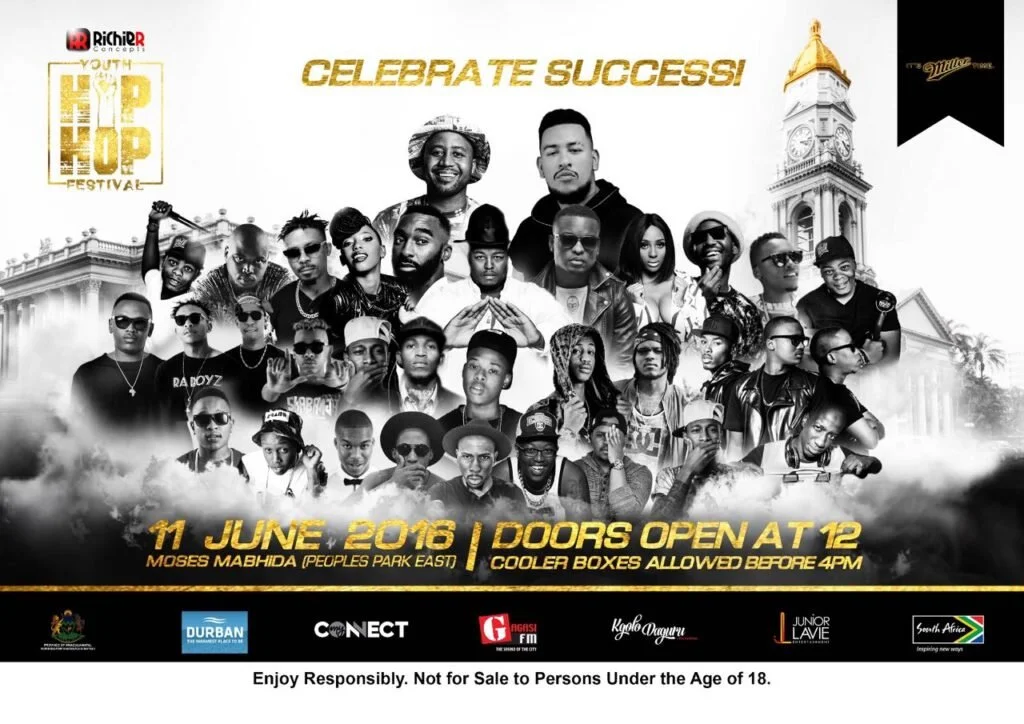
South Africa- With less than 10 days to go before the biggest hip hop festival in the country: The Annual Youth Hip Hop Festival; the excitement has officially hit the roof in South Africa's city of sun and fun; Durban.
Today concert promoters Richie R Concepts, Established Productions and KgoloDaGuru confirmed the full line-up to the highly anticipated annual gathering. With a joint decision made with all the relevant stakeholders... the People’s Park will be ‘set alight’ with the baddest beats and a 100% local South African line-up. "With the reaffirmation of patriotism in our country right now, this makes the most sense to the team. Together with our various partners, we decided to invest the funds into supporting and developing South African youth. It was an easy decision to use our money to grow our people” stated promoter Hlubi Radebe.
With the hope of attracting over 10 000 youth; organisers of the 3rd Youth Hip Hop Festival will work hand in hand with The KwaZulu Natal Provincial Government, Brand South Africa and media partner Gagasi FM. Concert gates open at 12PM and cooler boxes with refreshments are allowed before 4PM (but strictly no bottles). We also have a super performance for our early birds at 4PM, so concert-goers should try be there early!
The full line-up includes:
The Dons: CASSPER and AKA
Durban’s own: WTF, DREAMTEAM, AEWON WOLF
Royalty: RICKY RICK, OKMALUMKOOLKAT, ANATII, KO, KWESTA
The Cool Kids: EMTEE, GIGI LAMAYNE, MOOZLIE
DJ’S: MAJOR LEAGUE, DIMPLEZ, JNR DEROCKA, DJ SLIQE, LAB, TEABAG, DJ WOBBLY
FESTIVAL INFORMATION
Date: Saturday, 11 June 2016
Venue: Moses Mabhida Stadium , Peoples Park East
COMPUTICKET:
General Access: R160
Golden Circle: R280
VIP: R600
AT THE GATE:
General Access: R200
Golden Circle: R350
VIP: R600